Wednesday, June 1, 2011

Attracting spirit helpers

In my work as a shamanic counselor and drum maker, I am asked about how to attract spirit helpers. My first response is we have to taste good to what we are asking to come.
The other-than-human world loves what it finds to eat, but often avoids or challenges others of its kind. So if I want to attract eagle energy, I want to be more like a mouse instead of like another eagle. But how do I be a mouse to attract eagle as a spirit helper?

Many years ago I was giving a drum making workshop on the BC coast. Although the scenery was beautiful, the energy between the participants and myself was not. I understood from my shamanic guidance before the sessions began that this workshop was a lesson for me to "be a mouse" although at the time I didn't know what this meant. Because there were many issues of competition, judgment and self-promotion among the women and myself--I found myself rating my interactions at the end of each session according to "merits and demerits."

When I was annoyed at tardiness, or made veiled criticisms of someone's attitude, or required effort without a break--I gave myself a demerit for my lack of sensitivity. When I stayed detached and polite to another's self-promotion, watched for the best moment to share information rather than follow a schedule, felt kindness toward another's struggle--I gave myself a merit for being balanced in a sacred manner. Toward the end of the drum making workshop I had a revelation: this is how a mouse finds food. The mouse considers each seed for its nourishment or lack, it focuses on details as it moves along; the mouse builds a supply of what tastes good and knows what to avoid.

I believe my attention to detail and perseverance across the drum making workshop did attract spirit helpers who receive nourishment from these mice aspects. If you are wanting to attract spirit helpers, ask to be given experiences in which the energy of your actions will be good food for the spirit helper you are seeking. And then watch and learn from the experience.


Wednesday, May 25, 2011

How I begin a new shamanic painting

Before I begin a new shamanic painting I often find myself in a place that makes a strong impression on me. This ancient tree was growing in the beach sand at a state park in Kauai. It seemed impossible to me that roots so washed by the tides and covered with barnacles could still be so fully alive. Of course many people passed by it each day--some left their belongings draped on the curved wood while they went for a swim; others perched on its ledges to put on swim fins, or fastened the dog leash around a wooden opening. Once back on Cortes Island I remembered the image of the old tree, and connected this with some family genealogy research I have been doing into my recently discovered Scottish ancestors.

This connection between a place and a lived experience is how I choose an image to be a shamanic painting--by wanting to return to that place in paint, and then to journey within the painting process to learn more about the experience I am associating with the image. In this way every part of the painting has meaning as metaphor and symbol: the ancient roots growing up through sand, the footprints passing by, the spreading green of the branches with the sun caught in their web. As I paint I will consider these colors and forms as they apply to my family, as I consider my family I will create emphasis and focus with color and form.

But like many significant journeys, this new shamanic painting called family tree will begin in a modest way--by choosing the acrylic colors for my palette. I sample many paint combinations to find just the right warmth or coolness, the right intensity or softness of color. And each of these decisions is also part of the dialog between the lived event and the painted image that teaches me how to see deeply into my feelings, and how also to feel into what I see in nature.

Wednesday, May 18, 2011

Life takes a holiday


Sometimes our regular life takes a holiday. This has been my experience this week organizing the Cortes Island Seafest 2011, the oyster festival. Although there are lots of little bits to remember--everything from emails about finding shrimp chips to arranging who is picking up the mussels--coordinating lunch for 400 people served less than 4 hours has been a joy. It has been a continuous opportunity to feel grateful to volunteers and strangers who make just the right contribution, to friends who step up year after year to help, to a community that shows up. So I'm taking this week off from writing about the new drum I just completed, or the Journey Oracle card reading a friend just shared, or a new exhibition at the Cortes Island Old School House Gallery in June that features my journey into the Land of Faerie. Lets check in next week. Love Kristen

Wednesday, May 11, 2011

How to buy a drum

Shaman drums are called good horses, and I suggest someone looking to buy a drum approach the experience with this awareness. So what to consider when planning to buy a drum? Like with riding a horse--I want a drum that matches my way of going. Do I travel steadily, or is my shamanic drumming filled with bursts of energy and rapid beats? Do I want to buy a drum that like a good horse that can carry me across long distances of time, or do I want a drum companion that goes swift and deep in a short space of time.

Some drums, like some horses, move well with others by blending with and complimenting the flow of those moving nearby. Other drums, like wild stallions, overwhelm a group and are best ridden on a solitary journey. When someone comes to buy a drum, I suggest she go into a private space with all the possible drums and drum stick combinations, and go riding. Playing a drum and riding a horse cannot be understood through talking, but only through doing.

And just like some horses do, a drum can pick us. We may have our eye on a big, powerful shamanic painted drum--one with lots of vibration like rippling muscles across its surface--and a sturdy little Welsh pony of a drum keeps calling our attention back to its practical size and steady voice, indicating that our enthusiasm for drumming in sweat lodges or on backpacking trips will be well met.

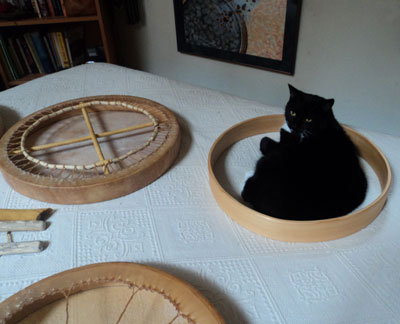
Perhaps the best advice I can give if you are planning to buy a drum--is to know yourself honestly and well--and then to not have a plan. Whether you read oracle cards, work with dreams, meditate or contemplate--explore how you really want to be with a drum. Then just be open and trust that like good horses everywhere, your drum will sense your presence by the gate, and will come slowly toward you of its own accord. I believe all spirit companions come to us like that. Of course, it also helps to ask a cat.

Wednesday, May 4, 2011

Looking at Art

As I am reviewing exhibition proposals to the Campbell River and District Public Art Gallery over these few days, and I found myself thinking about ways of looking at art. When I taught at the Nova Scotia College of Art and Design, I gave my art education students a four step method for looking at art that I still use. I'll demonstrate with one of my chalk pastel works that I offer as a shamanic art print on my Journey Oracle website.

The first step is to describe what I physically see, without using any art oriented vocabulary or psychological associations. I see a shape of crimson red in the lower left, above a white dome shape marked with facial features. The red shape transitions into white which further becomes bird and whale forms in the upper left. Vertical bands of ultramarine blue extend through the center of the picture plane and in the upper right transition into shapes of burnt sienna. A thin vertical band of lavender separates the blue from an emerald green shape that extends to the middle right margin. The lower right contains an area of visual details in which appear shapes of human faces. This first step often takes the longest. This first step is also what I do when first looking at an oracle card when conducting a Journey Oracle reading. I only describe what I see.

The second step involves using more formal art vocabulary to describe the visual elements that create relationships within the picture plane. Here I notice that all the colors are saturated--there are no pale or indistinct areas of color. I see that the white shapes draw the eye up the left side, across the top of the picture plane because of the center placement of a solitary bird form, and then down through the lightest green to a white area in the lower left. This creates a egg shaped circle which keeps the eye moving within the picture plane. I see strong diagonals ascending from the lower to the upper portion of the image, creating a visual flow that moves upward toward the bird and whale forms. When using this second step in a Journey card reading, I am noticing the color, shape and detail of the card image that stands out to my attention.

The third step is to let into my awareness any psychological, emotional or symbolic associations I am making. I particularly notice what I am feeling. I note that the intensity of color creates a feeling of drama. The addition of faces and animal / bird forms in unexpected locations creates a sensation of unreality--whether the scene is in the air or underwater or on earth is unclear. My overall impression is of looking into a place I do not understand where I cannot easily orient myself. During this step when reading an oracle card, I am noticing what general impression I have of the card. Am I feeling invited or unsettled; is there something requiring caution or surrender?

The fourth step is the inviting of meaning. When looking at art I finally now consider the artist's title and speculate on the intention. This piece is called Ode to Stones that Speak. The unreality and lack of orientation suddenly have a heightened sense of fit. This is not an ordinary reality. I now go back to my second step--of focusing on the art elements--and assign meaning to the relationships I see. The intense color saturation now connects to the density and mass of stones. The circular eye movement becomes a metaphor for the intensity of concentration required to enter an alternate reality. The visual flow upwards feels like going on a shamanic journey. In a Journey Oracle reading, this last step is also the inviting of meaning. How is this image from the Oracle an answer to my question?